

At a glance
- High-performing architectures often lack the interpretability required for safety-critical electric vehicle deployment and regulatory compliance.
- Data quality and availability, along with challenges in cross-domain transfer learning, currently constrain the generalizability of AI-based state-of-health (SoH) models across diverse battery chemistries and operating conditions.
- Hybrid physics-informed models and edge-optimized architectures offer promising pathways toward accurate, interpretable, and deployable battery management systems.
A Systematic Synthesis Across Architectures
Our paper provides a broad and systematic synthesis of AI-based state-of-health (SoH) prediction methods. We organize the literature by architectural lineage, spanning traditional machine learning, deep learning, and transformer models. The synthesis compares AI-based SoH prediction methods across these model families. By connecting methodological advances with practical considerations, we outline a pathway toward accurate, interpretable, and deployable AI models for SoH prediction.
Grounding the Synthesis in Public Datasets
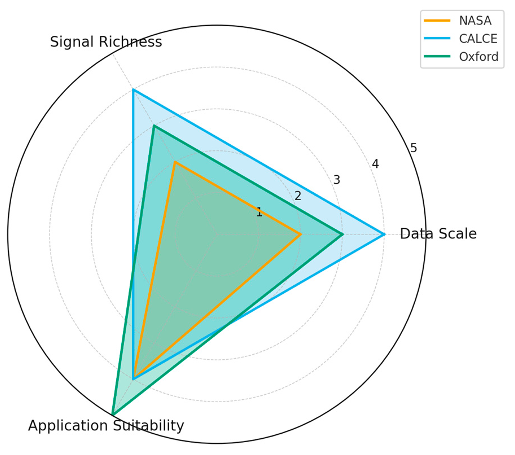
The empirical foundation for our comparative benchmarking relies on reported results from three widely used public databases: NASA, CALCE, and Oxford. These datasets are identified as the most commonly used in the field for battery SoH prediction. We do not conduct new experiments; instead, we synthesize the reported performance metrics from these established sources.
The Interpretability Gap in Safety-Critical Battery Management
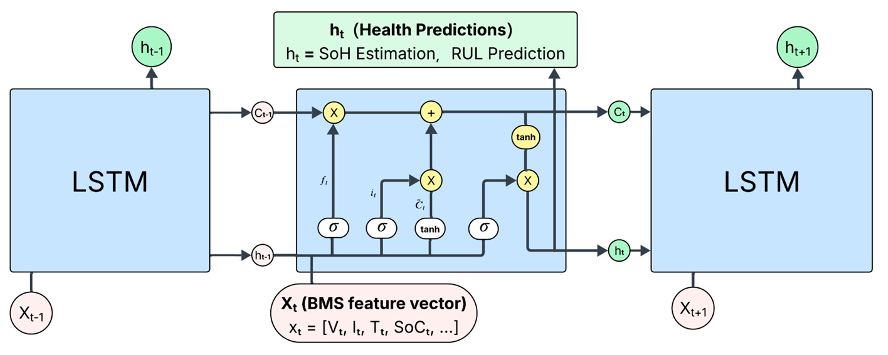
In safety-critical electric vehicle applications, interpretability is a fundamental deployment blocker. High-performing architectures like LSTMs and transformers often function as black boxes, making it difficult to trace a specific state-of-health or remaining useful life prediction back to a physical cause. This opacity complicates regulatory compliance, fault diagnosis, and the establishment of human trust in the system. The paper notes that systematic, battery-specific interpretability frameworks for these tasks remain underdeveloped. This gap highlights the need for explainable AI methods that can bridge the distance between high-accuracy data-driven learning and the transparency required for real-world battery management systems.
Constraints on Data Quality and Cross-Domain Transfer
The reliability of AI-based state-of-health models is constrained by two distinct challenges: data quality and cross-domain transfer. Existing datasets often suffer from limited coverage, inconsistent operating conditions, and incomplete life-cycle information, which directly limits prediction accuracy. Separately, models trained on specific battery chemistries or usage profiles frequently exhibit degraded performance when applied to different cell types or field conditions. The review frames robust cross-domain adaptation as an open research problem, noting that the scarcity of high-quality, long-term degradation data that represents real-world conditions hinders the deployment of these models beyond theoretical or experimental studies. These factors create significant barriers to generalizing AI-based state-of-health prediction across the diverse battery ecosystem.
Pathways to Deployable Models: Hybrid and Edge-Optimized Architectures
The review identifies several research directions for advancing state-of-health prediction, including hybrid models and edge-optimized architectures. One direction involves hybrid models that incorporate physics-informed constraints or electrochemical knowledge into data-driven learning. By bridging purely data-driven approaches with physical understanding, these models offer a promising pathway toward improved reliability, interpretability, and transferability. Another direction addresses the need for lightweight, edge-optimized architectures suitable for resource-constrained battery management system platforms. While techniques such as model pruning, quantization, and knowledge distillation are well-established in embedded AI, the review notes that their systematic application to battery-specific recurrent and attention-based models remains limited. These research directions highlight the ongoing work required to develop AI-based SoH models that are both physically grounded and efficient for embedded deployment.